







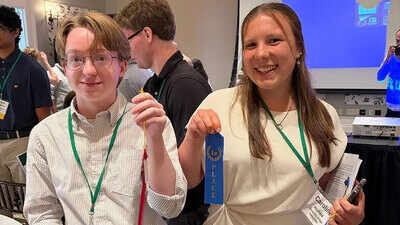
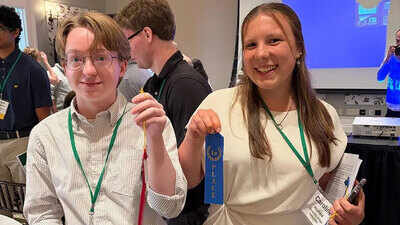
Two students from the University of New Hampshire at Manchester have secured first and second place for their undergraduate biomedical research presentations at the 2026 New Hampshire IDeA Network of Biomedical Research Excellence (NH-INBRE) Annual Meeting.Caroline Heafield, a biotechnology graduate from the Class of 2026, won first place for her research poster, while August Paquin, a biotechnology student from the Class of 2029, secured second place. The university announced the achievements on November 13.According to UNH Manchester, the annual meeting was held in August at the Omni Mount Washington Resort in Bretton Woods, New Hampshire. It brought together 290 students, faculty members, administrators and participants from other research programmes across the state to share scientific findings and recognise contributions to biomedical research.
Caroline Heafield wins first place for research on skin fungi
Heafield, a Millyard Scholar, received first place for her research poster titled “Investigating the Aggregation Behavior of Malassezia Fungi within the Human Skin Microbiota”.Her research focuses on Malassezia, a group of fungi naturally present on human skin, and examines how they aggregate within the skin’s microbial community. The study explores interactions between microorganisms and their human hosts.As reported by UNH Manchester, Heafield’s interest in microbiology began during an antibiotic discovery course at the university. As part of the course, she investigated bacteria collected from soil samples.She later expanded her research experience by studying fungal pathogens through a summer research programme at Dartmouth. She also received an Undergraduate Research Award from the university’s Hamel Center for Undergraduate Research to pursue an independent project examining fungi as potential sources of new antibiotics.Reflecting on the research opportunities available to her during her undergraduate studies, Heafield said, “The fact that I can have this experience as an undergraduate is incredible.”According to the university, these experiences have helped shape her interest in pursuing graduate studies focused on microbiology and human-microbe interactions.
August Paquin wins second place for AI-based research
Paquin, a biotechnology major from the Class of 2029, secured second place for his poster presentation, titled “Quantifying Ocular Pain in Mice Using Deep-Learning-Based Feature-Tracking Software”.His research examines how deep-learning technology can be used to measure ocular pain in mice by tracking physical features.The project explores the application of computational tools in biomedical research, particularly in developing methods to assess pain through feature-tracking software.
UNH Manchester showcases biotechnology through mobile laboratory
The university’s participation in the annual meeting extended beyond the student research presentations.According to UNH Manchester, its STEM Mobile Biofabrication Integrated Lab Experience, known as STEM-MoBILE, also participated in the event, offering attendees interactive biotechnology activities and hands-on laboratory experiences.The travelling laboratory is designed to introduce students and community members to biofabrication, an emerging field focused on producing human tissues using biological and synthetic materials.Through demonstrations, experiments and opportunities to use laboratory equipment, STEM-MoBILE aims to make scientific concepts more accessible and familiarise participants with educational and career opportunities in biotechnology.The university said its presence at the annual meeting provided an opportunity to showcase both undergraduate research and its efforts to expand access to hands-on science education.